



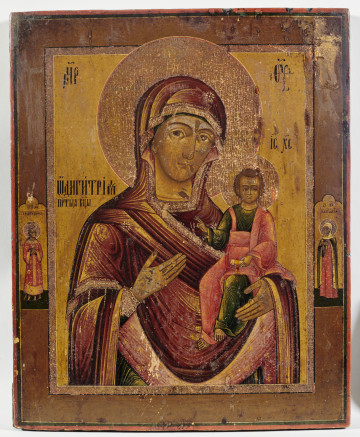
The Mother of God Odigitria, The Mother of God Odigitria of Smolensk
połowa XIX wieku
Castle Museum in Łańcut
Part of the collection: Ikony
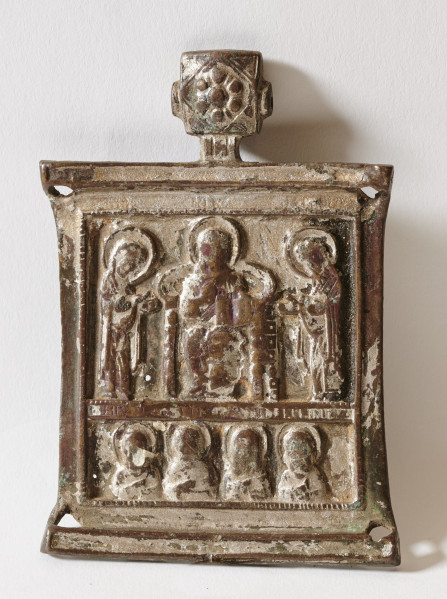
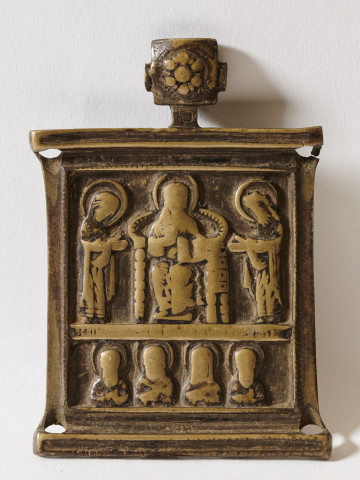
Cast brass icons were known in Ruthenia from the adoption of Christianity. They were later popularised by Old Believers who did not recognise the liturgical reform of Patriarch of Moscow Nikon between 1654 and 1659. The exhibited exhibit is the central wing of a tripartite icon (triptych) representing Deesis. The Greek word Deesis means supplication, a prayer made by the Church, through the saints, before the Enthroned Saviour. In Eastern Christianity, the origins of the image iconography date back to 6th or 7th century. This presentation is the subject of one of the rows of the altar partition known as the iconostasis, made in Russia in 16th – 17th centuries. In the basic variant, it depicts three persons: the Enthroned Christ, Pantocrator the All-Powerful and the greatest apostles of mankind addressing him, i.e. the Mother of God and St. John the Baptist. They epitomise the mystery of the Saviour's Incarnation accomplished with the participation of the Mother of God and attested by John during the Holy Spirit outpouring on the Son of God at his baptism in the Jordan. In addition to the traditional three-person “trimorphon” in the upper part of the icon, i.e. the Enthroned Pantocrator, the Mother of God and John the Baptist; the lower part of the composition features selected saints particularly venerated in the Old Believers' community, including St. Leontius of Rostov, St. Nicholas and Zosimas and Savvatiy of Sołowki.
Teresa Bagińska-Żurawska https://orcid.org/0000-0002-9243-3967
Author / creator
Object type
ikony
Technique
odlew cyzelowany
Material
brass
Creation time / dating
Creation / finding place
Owner
Muzeum - Zamek w Łańcucie
Identification number
Location / status
połowa XIX wieku
Castle Museum in Łańcut
XIX century
Castle Museum in Łańcut
koniec XIX w.
Castle Museum in Łańcut
DISCOVER this TOPIC
National Museum in Lublin
DISCOVER this PATH
Educational path