



Saint Anne with Mary, the Christ Child, and Emerentia
circa 1515 — 1520
National Museum in Szczecin
Part of the collection: Medieval sculpture of West Pomerania
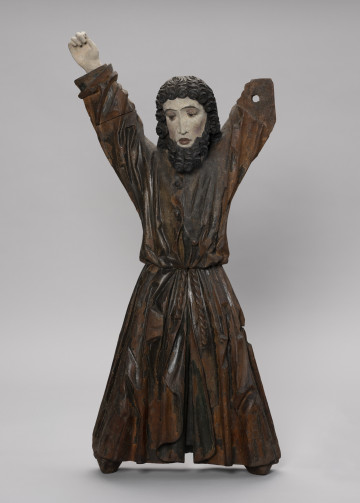
St. Veronica, a figure known from apocryphal accounts of the Way of the Cross, was deeply moved by Christ's suffering and demonstrated extraordinary compassion. Amid the hostile crowd on the way to Golgotha, she wiped Christ’s face clean of blood and sweat. The cloth, bearing the imprint of Christ's Holy Face – known as the veraicon – is, according to tradition, preserved in St. Peter's Basilica in Rome. It is one of the most important relics of the Church and is considered proof of the truth of the doctrine of the Incarnation. The veneration of the Holy Face and St. Veronica – an exemplar of piety and mercy – has been endowed with special graces, contributing to the motif's popularity, especially in late medieval art.
The three-dimensional depiction of Christ’s face in Pomeranian sculpture was designed to speak even more powerfully to the imagination of the faithful. The composition of the slender figure, with its characteristically elongated silhouette and delicate features, was inspired by Albrecht Dürer’s engraving St. Veronica between Saints Peter and Paul (from the Small Passion series, 1510). The sculpture’s wall-mounted design and size suggest it could have been the central figure of an altar retable. The graphic inspiration also hints that figures of Saints Peter and Paul may have flanked it. One such figure, the sculpture of St. Peter (MNS/Szt/41) preserved in the collection of the Szczecin museum, bears a similar form and similar detailing in the drapery, carved in large, flat planes, pointing to the work of the same artist.
Clear parallels can also be drawn with the figures depicted on large altar reliefs from Dąbie (MNS/Szt/169, MNS/Szt/170) and other works by the late medieval Szczecin workshop, such as the altar figures from Suliszewo. These similarities place this sculpture within the group of relics from the Szczecin artistic centre. The elongated proportions, typical of the workshop’s late phase, date the sculpture to the 1520s.
The sculpture is on display as part of the permanent exhibition The Mystery of Light: Medieval Art in Pomerania.
Kinga Krasnodębska
Author / creator
Object type
sculpture, figure, altar element, sacred object
Technique
sculpture, polychrome, gilding
Material
linden wood, paint, gold
Origin / acquisition method
acquisition
Creation time / dating
Creation / finding place
Owner
The National Museum in Szczecin
Identification number
Location / status
circa 1515 — 1520
National Museum in Szczecin
circa 1520
National Museum in Szczecin

circa 1430
National Museum in Szczecin
DISCOVER this TOPIC
National Museum in Szczecin
DISCOVER this PATH
Educational path