

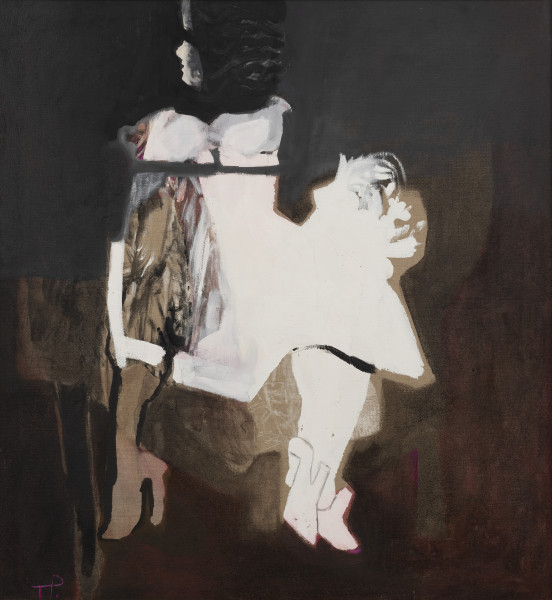

Twilight of Kings
1962
National Museum in Szczecin
Part of the collection: From neofiguration to the present day – the human condition in art
Teresa Pągowska (1926 to 2007) graduated from the State Higher School of Fine Arts in Poznań in 1951, receiving her diploma under Professor Wacław Taranczewski. Professionally, including as a university lecturer, she was closely associated with the artistic community of the Tricity, where she became part of a group gathered around the prominent painter Piotr Potworowski. She went on to teach in Gdańsk, Łódź and eventually at the Academy of Fine Arts in Warsaw. From the outset of her career, she was actively involved in the Polish art scene. Between 1950 and 1954, she took part in the annual National Fine Arts Exhibitions. In 1955, her paintings were included in the famous exhibition *Against War – Against Fascism* at the Arsenal, which became a symbol of rebellion against Socialist Realism and marked the beginning of the artistic thaw in post-Stalinist Poland. In 1959, Pągowska took part in the Biennale of Young Artists in Paris, and in 1961 she was invited by art critic Peter Selz to exhibit in *Fifteen Polish Painters* at the Museum of Modern Art in New York, alongside fifteen other Polish artists. The Communist era in Poland was a difficult time for art, and especially for a woman trying to carve out her space in a highly conservative, male-dominated art world. Her son, Filip Pągowski, recalls: “She was one of the very few female artists in Poland to hold such a position. She knew how to fight for herself and her work, even abroad. For many years, she had a good gallery in Switzerland, solo exhibitions in Paris and other European cities, and her works entered important collections. All this while being an artist from a communist country, where sorting anything out was a struggle, and where people from the East were viewed with suspicion. She didn’t talk about it much, but I know that some Polish male painters could be quite mean to her. Maybe they felt threatened by her work? At the time, gender equality mostly meant opening doors for women or kissing their hands, not giving them equal standing in public life. That all required her to summon an enormous reserve of energy.” Her painting *Woman-Rooster* (1979), held in the collection of the National Museum in Szczecin, is a quintessential example of her style and seems to embody the artist’s own personality and outlook on life. The title suggests determination and a drive for independence. The figure of the woman-rooster may symbolise a rebellious, uncompromising attitude towards societal norms. It invites reflection on gender equality, highlighting that women can be just as strong, dominant and fearless as men. Pągowska was fascinated by the human figure, particularly the female form, which she redefined in spectacular fashion through a painterly language rooted in colourism and balanced between figuration and abstraction. She transformed the classical theme of the human body into a modern idiom and developed a distinctive style that came to be recognised as a singular phenomenon in contemporary Polish art. Her paintings are a form of artistic acrobatics, maintaining a tension between the visible and the hidden, beauty and ugliness, the concrete and the ambiguous. Marlena Chybowska-Butler
Author / creator
Object type
painting
Technique
oil technique
Material
canvas
Origin / acquisition method
purchase
Creation time / dating
Creation / finding place
Owner
The National Museum in Szczecin
Identification number
Location / status
1962
National Museum in Szczecin
1989 — 1990
National Museum in Szczecin
1969
National Museum in Szczecin
DISCOVER this TOPIC
Castle Museum in Łańcut
DISCOVER this PATH
Educational path